Thursday, January 31, 2013

Why are Ag entities for animal cruelty & when will they meet with SB 171 supporters?

“Monday, Ag United met with various industry groups to form a strategy for battling South Dakota Senate Bill 171, the animal cruelty legislation. The measure would up violations from a misdemeanor to a felony. 
Clear Lake area South Dakota pork producer and Ag United Board member Paul Brandt says they believe the present misdemeanor law is adequate.

Brandt says SB 171 backers are being influenced by HSUS and other activist groups whose goal is to eliminate animal agriculture.

He doesn’t think SB 171 supporters will be able to get their bill out of committee.  However, if they do, Ag United and others will join forces to defeat the bill in the full legislature.”

In reviewing this story, we were shocked by the constant misinformation presented.  SDFACT is an all-volunteer group of South Dakotans working to make South Dakota the 49th state in the country with felony-level penalties for the most malicious acts of cruelty against dogs, cats and horses. 

1)         Mr. Brandt is incorrect, current laws are not adequate unless you are for animal cruelty. He should read about recent South Dakota cases and explain how a slap on the wrist is appropriate for these violent acts.
2)         Ag United once claimed SDFACT was a front group for the HSUS and now they are claiming South Dakotans are “being influenced by HSUS and other activist groups whose goal is to eliminate animal agriculture”. We are smarter than that Mr. Brandt, we are South Dakotans who have been working to pass felony animal cruelty laws in SD for 5 years and we haven’t been influenced by any activist groups – we did our own research and know our pets and communities deserve this protection. This bill has nothing to do with animal agriculture, why do Ag entities care about SB 171?

3)         Ag United and Jim Krantz in the email string below claim they were not discussing SB 171 at their meeting on Monday, but Mr. Brandt via WNAX claims the meeting did happen.  Which is it and why won’t Ag entities come together with South Dakota animal advocates to pass a law that works for everyone?

From SDFACT volunteers:

Dear Mr. Dick:

Following up on the email we sent January 11, we are now asking for your organization’s support of SB 171.  We are volunteers with South Dakotans Fighting Animal Cruelty Together (SDFACT), a group of SD citizens working to make South Dakota the 49th state with felony level penalties for the most malicious acts of cruelty against dogs, cats and horses.

We assure you SDFACT is a grassroots movement to pass a 2013 felony companion animal cruelty law and nothing more. We have not received any financial assistance from the HSUS or any other national organization. We are not a front group for any animal rights group; we are South Dakotans looking to protect our pets and communities from violent offenders.

We wish to work with your organization to ensure SB 171 passes this session and does not threaten the livelihood of your members or animal agriculture in South Dakota. Can we speak at your meeting of agriculture groups on Monday in Pierre to discuss SB 171? Please help us pass a law that works for everyone in 2013.

Sincerely,

Sara Parker                         Shari Kosel
Sioux Falls, SD                    Lead, SD

From Steve Dick Ag United:

Ms. Parker & Ms.  Kosel,

The agenda for the meeting was set by Jim Krantz with SDSU Extension Service.  Jim can be reached at Jim.Krantz@sdstate.edu

Steve Dick
Ag United for South Dakota

From Jim Krantz:

Steve, Sara, Shari,

Our meeting is at 2:00 this afternoon and we would not deny anyone the right to attend. However, our agenda does not include a discussion of the bills you referenced. Also, there will may not be sufficient time for everyone, including those who previously committed, to speak as we have some presentations and a conference call on the agenda. There will be time for comments from those attending on the material presented. Please call me on my cell if you have questions. 480-1056. Thanks.

From SDFACT volunteers:

WNAX's website says that Mike Held stated "South Dakota ag groups will be getting together in Pierre on Monday to talk about SB 171."

Is there another time that works for us to meet?


Unfortunately we have not received any response from South Dakota Ag United or any other Ag entities they represent who oppose SB 171, even though it does not affect animal agriculture in South Dakota.  We’ve reached out for their support on numerous occasions, as have many of you. We even asked to attend their meeting on Monday to discuss SB 171.  It appears South Dakota Ag groups intend to defeat this bill. We don’t have a paid lobbyist, we are volunteers with full time jobs and can’t stand in the lobbies of every Ag group in the state and force them to meet with us. 

If you are one of the South Dakotans who says this is a common sense bill that should pass this session, you aren’t alone. Let’s hope South Dakota Legislators will see the merits of SB 171 and not allow misinformation from Ag entities that represent 18% of the South Dakota population.  Please make sure your voice has been heard by members of the Senate Ag Committee and urge them to send SB 171 to the Senate floor. Watch for SB 171 to be added to the committee agenda and attend the public hearing in Pierre to let legislators know South Dakotans want felony level penalties for malicious acts of animal cruelty to protect our pets and communities from violent offenders.

Tuesday, January 29, 2013

SB 171 is as much about protecting communities from violent offenders as it is about protecting pets

Animal abuse never ends well and it is a red-flag to violent personalities and anti-social behavior. South Dakotans urge the passage of SB 171 to deter this behavior. This bill is as much about protecting communities from violent offenders as it is about protecting pets. Acts of intentional cruelty are often some of the most disturbing and violent offences and should be considered signs of serious psychological problems.  People who abuse and kill animals are more likely to target human victims. Serial killers and school shooters have histories of abusing animals. The FBI has recognized the connection since the 1970s, when its analysis of the lives of serial killers suggested that most had killed or tortured animals as children. Ted Bundy, Jeffrey Dahmer, Albert DeSalvo (the “Boston Strangler”) and many others committed heinous acts of animal cruelty before brutally maiming and killing their human victims. Over half of the infamous school shooters abused and tortured animals. (Miner, 1999)

The information below from the SPCALA further explains why SB 171 is as much about protecting South Dakota communities from violent offenders as it is about protecting pets.

Many studies in psychology, sociology, and criminology during the last 25 years demonstrate that violent offenders frequently have childhood and adolescent histories of serious and repeated animal cruelty. The FBI has recognized this connection since the 1970s, when its analysis of the lives of serial killers suggested that most had killed or tortured animals as children. Other research shows consistent patterns of animal cruelty among perpetrators of more common forms of violence, including child abuse, spouse abuse and elder abuse.

  • High school killers such as 15-year-old Kip Kinkel in Springfield, Ore., and Luke Woodham, 16, in Pearl, Mississippi., tortured animals before embarking on shooting sprees.
  • Columbine High School students Eric Harris and Dylan Klebold, who shot and killed 12 classmates before turning their guns on themselves, bragged about mutilating animals to their friends.
  • Serial killer Jeffrey Dahmer had impaled dogs’ heads, frogs, and cats on sticks.
  • Carroll Edward Cole, executed for five of the 35 murders of which he was accused, said his first act of violence as a child was to strangle a puppy.
  • Albert DeSalvo, the “Boston Strangler” who killed 13 women, trapped dogs and cats in orange crates and shot arrows through the boxes in his youth.
  • Patrick Sherrill, who killed 14 coworkers at a post office and then shot himself, had a history of stealing local pets and allowing his own dog to attack and mutilate them.
  • Brenda Spencer, who opened fire at a San Diego school, killing two children and injuring nine others, had repeatedly abused cats and dogs, often by setting their tails on fire.
  • Earl Kenneth Shriner, who raped, stabbed, and mutilated a 7-year-old boy, had been widely known in his neighborhood as the man who put firecrackers in dogs’ rectums and strung up cats.
  • In 1987, three Missouri high school students were charged with the beating death of a classmate. They had histories of repeated acts of animal mutilation starting several years earlier. One confessed that he had killed so many cats he’d lost count. Two brothers who murdered their parents had previously told classmates that they had decapitated a cat.

SB 171 isn’t just about protecting pets; it is about protecting South Dakota communities from violent offenders. Fortunately cases of malicious animal cruelty are rare but they must be treated like real crimes in South Dakota.

Contact members of the Senate Ag Committee via this link: http://legis.state.sd.us/sessions/2013/CommitteeMembers.aspx?Committee=2. Ask them to send SB 171 to the Senate floor because South Dakotans want to protect our pets and communities from violent offenders.

Monday, January 28, 2013

Ag entities meeting today in Pierre; animal advocates not invited

According to a recent story on WNAX Lobbyist Mike Held with the South Dakota Farm Bureau stated Ag groups are getting together today in Pierre to talk about SB 171. No one from SDFACT was invited to participate, in fact, we contacted all SD Ag groups asking to speak at their meeting and we received no response.

If you are a member of the South Dakota Farm Bureau, contact Executive Director Wayne Smith and Lobbyist Mike Held and let them know you want to see SB 171 passed in 2013.

We’d also like to correct Mr. Held’s remarks in the story:

1) These efforts are not coming from “out of state animal rights activists”. SDFACT is volunteer effort based right here in South Dakota and we are not getting ANY funding from HSUS or any other agency.

2) “Many ranchers use horses to work cattle”. This bill is only for aggravated cruelty that is malicious and intentional. An accident or injury that happens while herding cattle would not be applicable under this bill (assuming the owner gets the animal treatment and doesn't let it needlessly suffer).

You can read the complete bill at http://legis.state.sd.us/sessions/2013/Bills/SB171P.pdf and see for yourself that it will NOT affect agriculture in ANY way.

It seems Mr. Held is also concerned about the prospect of a ballot initiative and what it could cost agriculture to defeat. SB 171 has been introduced and our goal is to see it passed in 2013. Although animal advocates are frustrated, there has been no discussion of a ballot initiative because we believe the South Dakota Legislature will pass SB 171 because it is what South Dakotans want. We wish to discuss the merits of SB 171 and we dismiss attempts by Ag opposition to link SDFACT and all South Dakota animal advocates with national animal rights activists. Battling misinformation from Ag entities and their lack of interest in including South Dakota animal advocates in the conversation makes the battle to get SB 171 out of committee and to the Senate floor even greater. Please contact members of the senate Ag Committee today via this link: http://legis.state.sd.us/sessions/2013/CommitteeMembers.aspx?Committee=2 and urge a 'do pass' of SB 171.

Saturday, January 19, 2013

Will a fifth attempt to strengthen animal cruelty laws come to an end next week?

North Dakotans recently introduced a comprehensive animal cruelty bill to provide felony level penalties for the worst acts of cruelty and reform their animal cruelty code. SB 2211 will be heard ND’s Senate Ag Committee on January 24. The bill has overwhelming support from Ag entities and animal advocates alike. We congratulate North Dakotans for recognizing the link between animal cruelty & human violence, and applaud their efforts to pass meaningful legislation for animals in 2013.
If the ND bill passes, South Dakota will become the only state in the country without felony level penalties for the most egregious acts of animal cruelty. It will be a sad day in South Dakota when our fifth attempt at improving SD animal cruelty laws comes to an end. But don’t beat yourselves up and don’t blame the South Dakota Legislature – Ag interests dictate the legislative agenda in Pierre, so unless they are willing to come to the table we may never see laws improve for animals. 
The effort to strengthen SD animal cruelty laws started in 2008 when then forty-three states had enacted felony penalties for certain acts of animal cruelty – acknowledging the proven link to human violence. Animal advocates from across South Dakota began working together to introduce a bill in 2009.  HB 1146 prohibited the torture of animals and provided felony level penalties for the worst acts of cruelty. The bill was sponsored by Representatives Cutler, Krebs, Novstrup (David), Rausch, and Schrempp and Senators Abdallah, Dempster, Gillespie, and Gray. However when the bill was presented to the House Judiciary Committee, Ag lobbyists said the bill was too far reaching and could negatively impact animal agriculture; the bill died in committee.
In 2010, South Dakota advocates again tried to introduce a bill addressing the torture of animals but no sponsor was secured. In an effort to ward off a third attempt at strengthening SD animal cruelty laws, Ag entities formed the Animal Care Law Review group. The group was spearheaded by the South Dakota Pork Producers, SD Association of Cooperatives, SD Cattlemen’s Association, and South Dakota Farm Bureau. They invited the SD state vet, several members of the South Dakota Animal Control Association, several dog breeders and a SD humane society director to participate. Their report claimed they spent the summer gathering input from group members on South Dakota’s laws dealing with animal care and humane treatment. However in speaking with participants they met only twice and the moderator led group members to conclude no statutory changes are needed stating “South Dakota has a proud and rich history of animal ownership and husbandry.”

At the start of the eighty-sixth legislative session, the handout below was distributed to members of the House and Senate Ag committees. Lobbyists with the SD Association of Cooperatives, SD Cattlemen’s Association, South Dakota Farm Bureau and South Dakota Pork Producers presented the Animal Care Law Review group findings at committee meetings in January 2011. They reported SD’s existing animal laws are sufficient; the process for reporting and responding to cruelty complaints is solid; and only out-of-state radical anti-agriculture groups think South Dakota animal cruelty laws should change. That year, dozens of South Dakota animal advocates again contacted their legislators asking for the introduction of a bill addressing the torture of companion animals, but Ag lobbyists successfully blocked this effort citing the findings of their Animal Care Law Review group. 
In 2012 South Dakota animal advocates tried again; seeking protection for pets. In a forth attempt to introduce a bill, they presented legislators with a draft so specific it would make only the torture of cats and dogs a felony in South Dakota. Was this still too far reaching? Apparently so because Ag lobbyists went one step further and convinced legislators to introduce HCR 1006. This resolution, drafted by the South Dakota Farmers Union, was in opposition to certain actions by animal rights groups and it was sponsored by Representatives Fargen, Brunner, Conzet, Cronin, Dennert, Feickert, Gibson, Greenfield, Hawley, Hoffman, Hunhoff (Bernie), Iron Cloud III, Jones, Killer, Kirschman, Kloucek, Kopp, Lucas, Lust, Nelson (Stace), Olson (Betty), Rausch, Russell, Schaefer, Schrempp, Sigdestad, Street, Turbiville, Vanneman, Verchio, White, Wink, and Wismer and Senators Krebs, Begalka, Bradford, Brown, Frerichs, Gray, Hansen (Tom), Hundstad, Juhnke, Lederman, Maher, Nelson (Tom), Olson (Russell), Rampelberg, Rave, Rhoden, Schlekeway, Sutton, and Vehle. This resolution passed unanimously to support SD’s number one industry, agriculture – and legislators were not even willing to discuss a bill with their own constituents in the fear of being associated with radical anti-agriculture animal rights activists.
At the conclusion of the eighty-seventh legislative session, South Dakota animal advocates began discussing a bill that would protect companion animals and SD communities from violent offenders. It was specifically drafted to exempt traditional Ag practices in the hope this would appease members of Ag opposition. An all-volunteer grassroots group of South Dakotans began contacting their elected officials and district candidates about a felony companion animal cruelty bill prior to the November 2012 elections. In December support of legislators was secured but no prime sponsor identified.
This brings us to today – the bill introduction deadline for South Dakota’s eighty-eighth legislative session is just days away and we’ll keep trying to secure a prime sponsor. In the end South Dakota animal advocates may not succeed and our fifth attempt to pass a law forty-eight other states saw fit to pass years ago, may fail. We’ve done everything we can – we spoke up and we provided the facts.  Constituents in almost every legislative district contacted their leaders and we asked SD Ag organizations for their support but received no response.
The truth is Ag entities are using misinformation and fear tactics to influence legislators – our elected officials, the very individuals we selected to represent us. So we can thank Ag United, Midwest Dairy Association, South Dakota Soybean Research & Promotion Council, South Dakota Poultry Industries Association, South Dakota Corn Utilization Council, South Dakota Corn Growers Association, South Dakota Beef Industry Council, South Dakota Soybean Association, South Dakota Farm Bureau, South Dakota Pork Producers Council, South Dakota Cattlemen's Association, South Dakota Dairy Producers, South Dakota Associations of Cooperatives and the South Dakota Farmers Union for the fact South Dakota pets still have no protection in 2013.
If you are a member of any of these groups call and ask them to champion this bill that excludes traditional Ag practices and protects companion animals. But if you aren’t a member – ask yourself why legislators place more emphasis on the wishes of 18% of our state’s population (those these Ag groups represent), than they do on the wishes of other South Dakotans. There is no reason South Dakota should be the only state in the country where it is okay for an individual to violently kick a Chihuahua until it’s unconscious and seizing; to beat a pet cat to death with a hammer; to bludgeon a prized hunting dog in its kennel; or to cut the ears off a puppy with a steak knife and receive a sentence that amounts to that of speeding ticket. These acts are violent. They need to be treated like real crimes. Malicious and intentional animal cruelty should be a felony, it is just that simple.

Why does South Dakota need felony penalties for the most egregious acts of animal cruelty?

South Dakota needs to treat violent acts of animal cruelty like real crimes. One would think admitting to beating your pet to death with a hammer would warrant a higher penalty than that of a speeding ticket - but not in our state.

According to a January 25, 2012 article in the Yankton Press & Dakotan, a Yankton woman was arrested after she allegedly pummeled her cat to death with a hammer. Mary Thompson, 52, was arrested for killing or injuring an animal, a class 1 misdemeanor just two days after the incident.

According police reports, the manager of Canyon Ridge Apartments called police at 11:40 a.m. on January 23 and said she witnessed Thompson killing a cat. The manager said she had gone to visit Thompson about having two cats in her apartment because tenants were allowed to have only one pet.

Thompson previously told the manager she would be giving away one of her cats. Upon being told that both cats still resided in the apartment, the manager again told Thompson that another home would have to be found for one of them. At that point, the manager told police Thompson went to the kitchen, grabbed a small hammer and went to the couch where one of the cats was resting. She then allegedly grabbed the cat by the neck and began to strike it on the head with the hammer. The manager said she began screaming and fled the apartment in fear because of what she had observed.

Another witness said he later saw Thompson holding what appeared to be a bag and leaving the apartment complex. A blanket was later found in a dumpster near the apartment. According to a police report, Thompson admitted to police that she had killed the cat and disposed of it in the dumpster before being arrested. Police chief Brian Paulsen said a search warrant was executed on the apartment Tuesday to see if the second cat was alive and to recover evidence.

We never heard anything further on this case after this initial report of the incident. We watched for an outcome and waited for media reports on the malicious bludgeoning of Thompson’s pet cat but nothing was reported. SDFACT recently pulled Thompson’s criminal records and according to a report from the South Dakota Unified Judicial System, Mary Thompson pled guilty to a lesser charge of disorderly conduct on November 7, 2012 and was sentenced on December 19, 2012 to 14 days in jail suspended, a $166 fine, Thompson was required to repay Yankton County for her court appointed attorney and ordered to have no similar offenses for 360 days - once again a slap on the wrist for a violent offenders in South Dakota who viciously tortures a pet.

Violent acts of animal cruelty must be treated like real crimes in South Dakota because there is legitimate evidence that individuals involved in violent acts against animals present a danger to the public that must be addressed. A felony companion animal cruelty law would provide prosecutors with another option when dealing with violent acts against pets. Contact your legislators today, share this story and ask them to sponsor and champion a felony animal cruelty bill in 2013 - because our pets and communities need protection now.

Wednesday, January 16, 2013

Violent acts of animal cruelty don't happen often; but that doesn't mean we don't need stronger laws

Fortunately violent acts of animal cruelty don't happen often in South Dakota, but that doesn't mean we don't need stronger penalties, as opponents to this legislation suggest. In another effort to mislead the public, they claim there was only 1 case of animal cruelty in SD in 2012, sighting petabuse.com. According to SD DCI statistics, there were 97 arrests for animal cruelty in the last 5 years (including one for bestiality) and our research shows that only a small percentage of those cases are truly violent acts against pets.

Regardless, the opposition's argument makes no sense. So we shouldn't have strict laws for murder in South Dakota because it doesn't happen very often? We see an average of 22 murders each year in South Dakota, does that mean we don't need laws in place to deter behavior and protect the public?

The fact is felony penalties for malicious acts of cruelty against pets will provide prosecutors with another option when dealing with violent offenders. Felony animal cruelty laws may not be used often, as our friends in Nebraska admit, but for cases like Shy's, where a beloved family pet is beaten to death - the consequences need to be more severe.

In June 2011, Shy, the Ludwig family's German Shorthaired Pointer and prized hunting dog was brutally beaten to death with a hammer by one of their Burbank neighbors. A witness heard the dog screaming and saw Robert Kyte leaving Shy's kennel with a bloody hammer. Chief Deputy Jerami West said "It kind of makes your heart drop. Who could do this to animal? It appeared to me as rage."

Initially, Kyte was charged with killing or injuring the animal of another (a Class 1 misdemeanor), as well as intentional damage to property in the first degree (a Class 6 felony). The felony charge for destruction of property (Ludwig's dog) was only possible because Shy was a prized hunting dog and his value was over $1000. Obviously most pets adopted from shelters and rescues aren't valued at $1000+ so this charge was rare. Had the felony charge been maintained, Kyte could have faced up to two years imprisonment in the state penitentiary, a fine of $5,000 or both. However in August 2011, Clay County State's Attorney Teddi Gertsema said Kyte plead guilty to intentional damage to property in the second degree and killing or injuring the animal of another, both of which are Class 1 misdemeanors. Kyte was sentenced to no jail time, a fine of $300 plus $84 in court costs for each misdemeanor count. Now those consequences certainly don't mirror the actions according to the Ludwig family and many other South Dakotans.

There is legitimate evidence that individuals involved in violent acts against animals present a danger to the public that must be addressed. The Ludwigs know this well and they are imploring people to write their leaders to increase the penalty of a crime like this, "We have four children, two are younger and they are scared to go outside now because of him [Robert Kyte] and what he's done, terrorized our family and brutally killed our dog," said Kim Ludwig.

The South Dakota Legislature must take action in 2013 because our animals need protection now. We are one of only 2 states in the country without felony penalties for the most malicious and violent acts of animal cruelty and we need your help. Email your legislators now using this link: http://legis.state.sd.us/who/index.aspx and call the Senator Lobby at 605.773.3821 and the House Lobby at 605.773.3851. You can leave a message with the lobby receptionist following up on the email you sent - ask your legislators to create and pass a felony companion animal cruelty bill in 2013. There are only a few more legislative days to get a bill introduced this session and our pets can't wait until 2014.

South Dakota ranks last in country for animal protection laws; HSUS 2012 Humane State Ranking Report

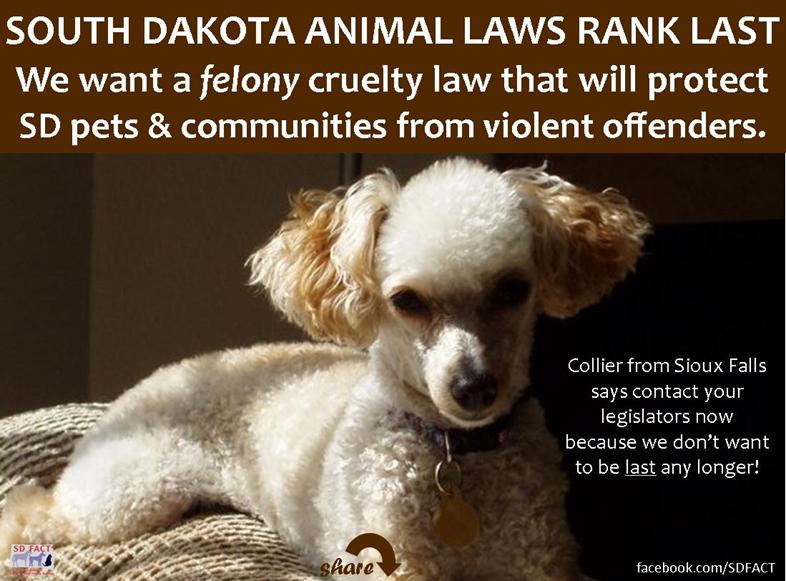
On Tuesday the Humane Society of the United States (HSUS) released its 2012 Humane State Ranking report, a comprehensive analysis of animal protection laws in all 50 states and Washington, DC. States were graded on the strength of laws to reduce animal suffering, including animal cruelty codes, equine protection standards and wildlife management. South Dakota has once again been ranked last, scoring a mere 14 percent. South Dakota & North Dakota are the only two states with no felony-level penalties for egregious acts of animal cruelty which contributes to their low rankings. To see the complete HSUS 2012 Humane State Rankings, click here.

South Dakotans Fighting Animal Cruelty Together (SDFACT) is a local grassroots group of South Dakotans advocating for felony companion animal cruelty laws. The group is currently working on securing a 2013 bill sponsor for the most egregious acts of animal cruelty to protect pets and the safety of our communities. “Constituents in almost every South Dakota district have contacted their legislators,” says Sara Parker of Sioux Falls. “We’ve even reached out to South Dakota Ag organizations who have voiced opposition to prior legislative efforts.” SDFACT believes South Dakota Legislators will listen to their constituents and introduce a bill in 2013 that protects pets and is also palpable to Ag entities.

Current penalties for starting a cat on fire are the same as writing a bad check and this doesn’t sit well with South Dakotans. “I’m a South Dakota native and I have been advocating for animals for many years,” says Shari Crouch Kosel of Lead. “An individual would receive a stiffer penalty for destroying a painting of a dog than torturing and destroying the actual dog; we simply want to protect pets and our communities from violent offenders.” There is legitimate evidence that individuals involved in violent acts against animals present a danger to the public that must be addressed.

While statistics show South Dakota sees only a small number of violent animal cruelty cases annually, SDFACT says this doesn’t mean felony penalties are not needed. The National Coalition Against Domestic Violence conducted a study in which 85.4 percent of women and 63.0 percent of children reported incidents of pet abuse after arriving at domestic violence shelters. Intentional animal abuse is often seen in association with other serious crimes including drug offenses, gang activity, weapons violations, sexual assault and domestic violence – and can be one of the most visible parts of an entire history of aggressive or antisocial behavior.

Please contact your South Dakota legislators today. The bill filing deadline is next week (January 23) and we don’t want to wait until 2014 to get protection for our pets. Email us at sdfact@gmail.com if you would like supportive documents and tips on contacting your legislators.